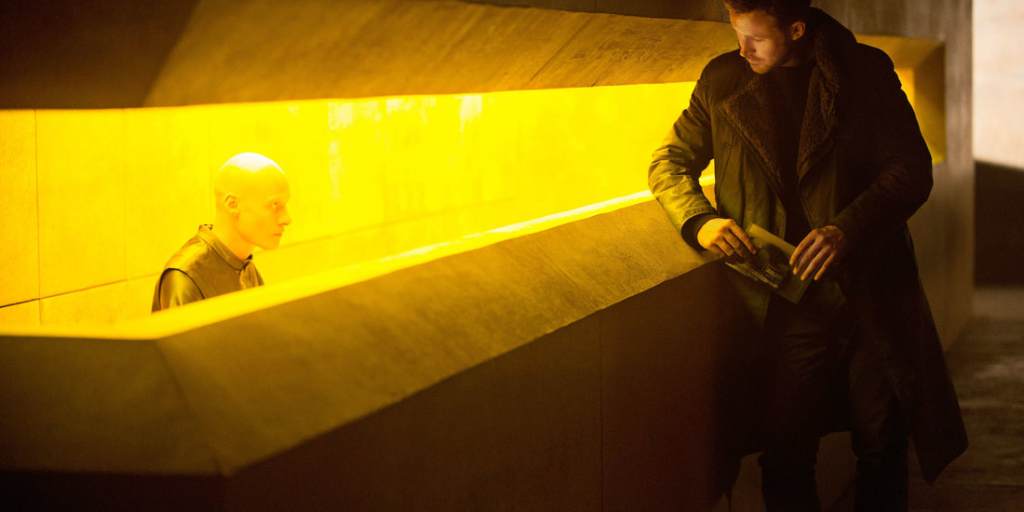
In Blade Runner 2049, the main character, “K” is charged with locating information. He heads to the archives where he is told by the archivist that there is not much information available for things that happened before the “Blackout.” We can deduce that this Blackout event destroyed an enormous amount of records as well as other digital information; this makes K’s job much more difficult. DNA from a discovery leads K to a piece of the data, found on card-catalog-esque panes of glass that then direct him to small, glass balls of data, which are read using a specific device (see below). Eventually, this small piece of information leads him to his answer. It’s the data that gets the ball rolling, as it were, and the mystery is eventually resolved.

What strikes me as interesting are two things. 1) The formats of the data – while the information is somewhat digital it is stored on tangible objects, like glass cards, and spheres. Something solid seems more real, and the tactile-ness of these objects, their delicacy, makes them appear more precious. 2) The awareness that data is fragile – there is always the possibility that it can be lost. In the movie these valuable data containers are glass. If they’re dropped, the data is gone, and that is just the way it is. Lost forever, oh well.

Memories also play a large role in the film. Replicants are implanted with machine-stored memories, created by other individuals, based on both fictional and real events, and these memories trick replicants so they are unaware of their immortality. Some replicants know the memories belong to another and are aware of their purpose. Others are unaware and believe that the memories actually belong to them. The authenticity and value of a being are based on its ability to make its own memories and to have truly experienced what they can recall. Here again, these digital archives store what is most precious to us.
The original 1982 Blade Runner, explored themes and ideas, such as, “what it means to be human, the importance of memories and how our obsession with technology could lead to societal and environmental decay” (Engaget). While those ideas are in our collective conscious, on the whole, humans must be self-reflective enough to comprehend the importance of memories. Unfortunately, many have relegated the responsibility of remembering to digital algorithms and timelines.
I recall reading a piece a while ago, which talked about how for each important moment in history, eventually, there are no people alive who actually witnessed, experienced, or lived it, and how the only record that remains are the stories those original witnesses have passed on to others. These second-hand accounts are the archives of verbal histories, affected by time, memory, and subjectivity. It feels important for there to be some official and accurate record of the people who once were.
There is no guarantee that records of importance will be maintained – no universally followed protocol, no expectations for methods of retention – no way to preserve a global truth. The once-certifiable documentation traditionally relied upon, newspapers, photographs, microfiche, archives, etc. are now called into question. Neo-nazis proudly walk in the street, an elected official acts like a petulant child – we see our efforts to record what has happened (in order to prevent our being doomed to repeat it) may have all been for naught. When I think about the Memorial to the Murdered Jews of Europe in Berlin, and how the monument is there to concretize what happened, to honor the people who died, and to express the remorse, I think of how impermanent even those stones are. How easy it can be for some crazy dictator, or some crazy dictator-like person to rise to power, and demand all the monuments be destroyed, all the records destroyed. Nothing but our flawed stories will remain.
“There’s a school of thinking that says if you can’t do it right, don’t do it at all…But the thinking is, let’s do what we can.” The problem with this thinking is if you say you are doing it, no one else will feel they have to. Vigilance is essential in preserving truth and, it turns out, is essential to our humanity.
Refs:
Adrienne Lafrance (n.d.). The Internet’s Dark Ages. The Atlantic. Retrieved from http://www.theatlantic.com/technology/archive/2015/10/raiders-of-the-lost-web/409210/
Engadget (20 Oct. 2017.). Designing the technology of ‘Blade Runner 2049’. Engadget. Retrieved from https://www.engadget.com/2017/10/20/designing-the-technology-of-blade-runner-2049/
N.a (n.d.). maxresdefault.jpg (1280×720). I.ytimg.com. Retrieved from https://i.ytimg.com/vi/L4TnjgQQ2Q0/maxresdefault.jpg
Phil Hornshaw (7 Oct. 2017.). ‘Blade Runner 2049’: What Exactly Is ‘the Blackout’?. TheWrap. Retrieved from https://www.thewrap.com/blade-runner-2049-exactly-blackout/
Setaprint (11 Oct. 2017.). Stills from Blade Runner 2049 | Setaprint, an archive for visual inspiration. Setaprint. Retrieved from http://www.setaprint.net/2017/10/stills-from-blade-runner-2049/
Trailer Addict (28 Aug. 2017.). Blade Runner 2049 TV Spot – Answers (2017). Trailer Addict. Retrieved from https://www.traileraddict.com/blade-runner-2049/tv-spot-answers
Trailer Addict (30 Aug. 2017.). Blade Runner 2049 (2017) – Short Film – 2036: Nexus Dawn. Trailer Addict. Retrieved from https://www.traileraddict.com/blade-runner-2049/short-film-2036-nexus-dawn
 MmePrice
